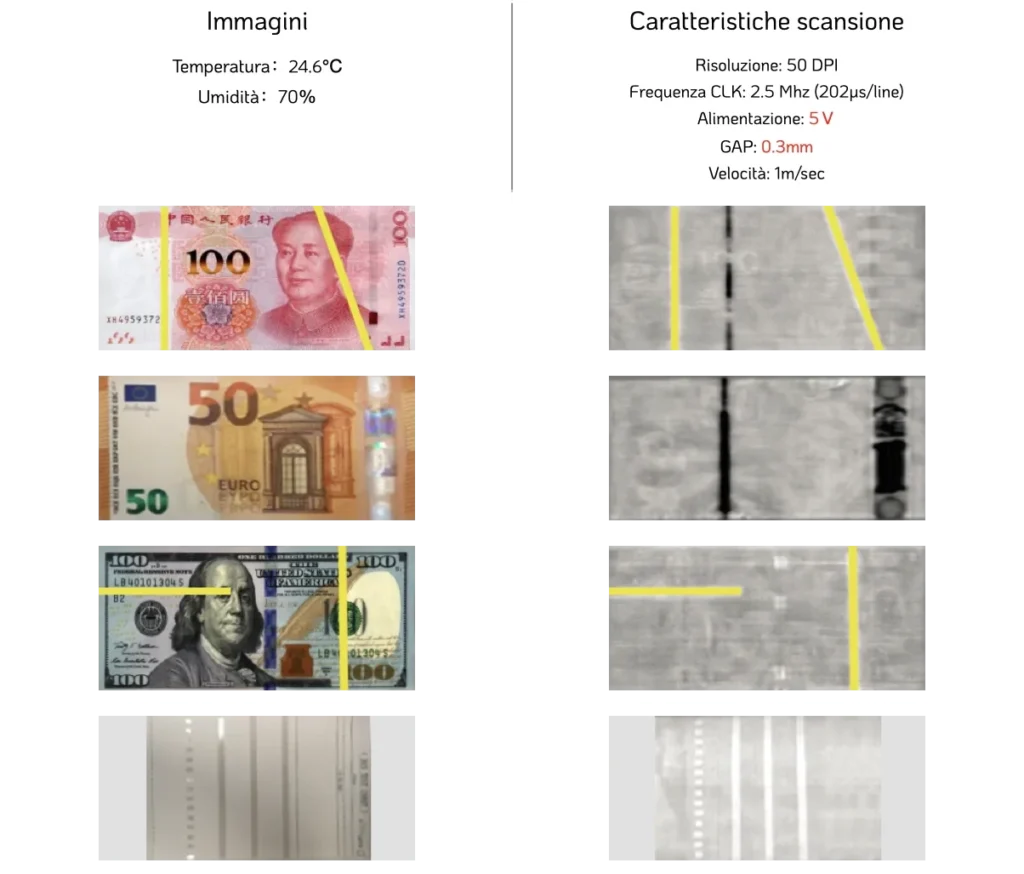
DIS is an image sensor based on electrostatic capacitance detection. As the document passes through, it generates a continuous image of the capacitive response, useful for highlighting physical and material anomalies on the banknote.
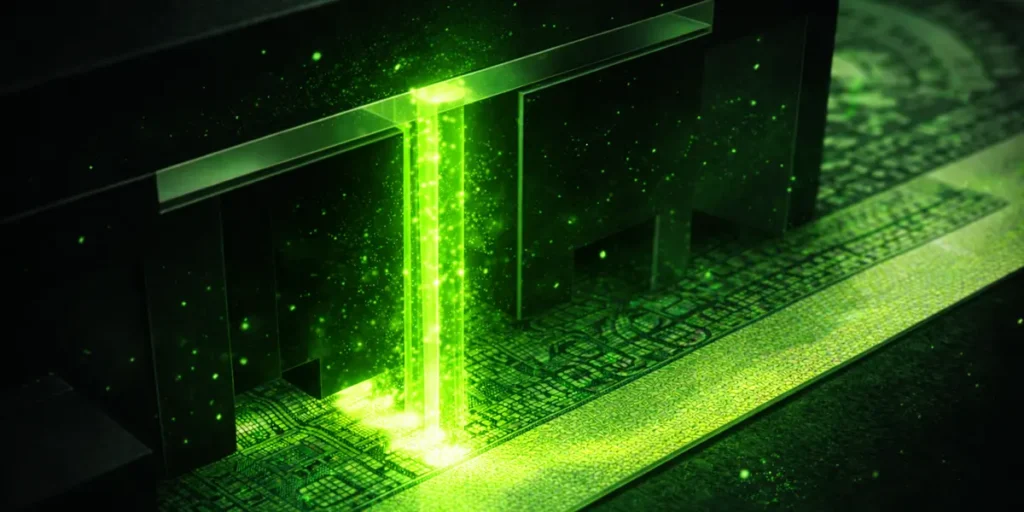
Operating principle
The DIS detects changes in electrostatic capacity between the sensor and the document in transit.
Local variations (additional layers, foreign bodies, different materials) modify the capacitive response along the scan width.
The system converts the response into:
- a dedicated analog channel
- a serial digital output, so as to obtain an image (map) that can be used by the processing electronics.
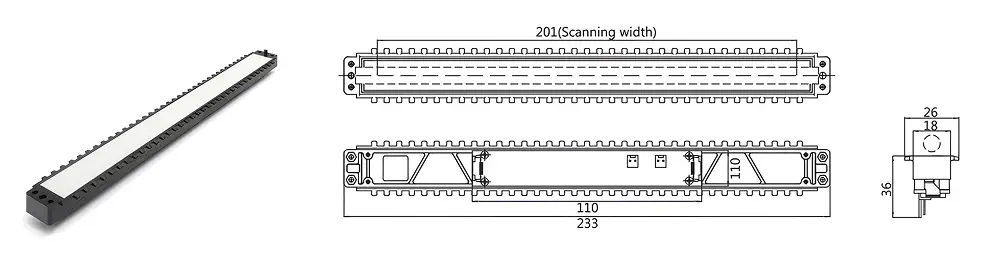
ADVANTAGES
- High resolution up to 50 dpi
- Low noise
- Compact size and light weight
- Easy assembly
- Optimized for electrostatic capacitance detection

What can it detect?
The DIS recognizes:
- Double or overlapping banknotes
- Metal staples or adhesive tapes
- Cutting defects or edge deformations
- Conductive areas or special materials (metallic inks, security threads)
- Tactile markings or reliefs used as a security feature in modern currencies
In a validation system, this data is combined with optical and magnetic data, allowing for the automatic rejection of anomalous or potentially dangerous documents.
Integration and synergistic operation
In a typical multi-sensor architecture, the DIS can be integrated, downstream of the CIS and MIS, to add capacitive document control.
All three modules share the same clock signal and read length, so they return a scan
synchronized per pixel.
Thanks to this integration:
- the machine distinguishes a folded banknote (physical error) from a counterfeit one (optical/magnetic error);
- can intelligently manage the flow of documents, avoiding mechanical blocks or incorrect counts;
- It increases processing speed, because mechanical and authenticity verification take place in the same step.
MAIN ADVANTAGES
- True three-dimensional sensing, based on physical properties.
- High sensitivity to thicknesses and overlaps, even minimal ones.
- Absence of optical parts, therefore no influence from ambient light.
- Zero maintenance: sealed and stable structure over time.
- Direct interface with microcontrollers or FPGAs via SPI or analog output.
APPLICATIONS
- Banknote validation and counting systems (sorter, validator, recycler).
- Scanner for checks or valuable tickets.
- Double or fold presence checks in automatic feeding lines.
- Detection of foreign objects or mechanical errors in document conveyor lines.
DIS Images